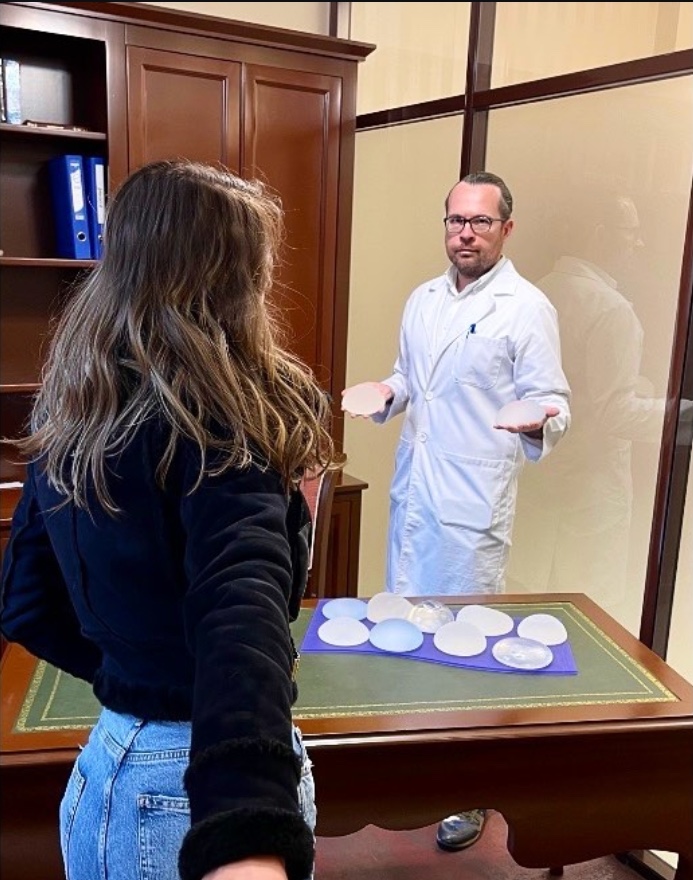
I’m Dr Dinu Dumitrașcu, a surgeon and also a lecturer at the University of Medicine in Cluj. I created an information campaign that aims to bring accurate information about beauty closer to the people looking for it.
The third episode of the #frumuseteaesanatate campaign is about how we decide whether to have surgery, whether it’s the right choice or not, and how the surgeon–patient relationship should work.
QuestionIs it a personal choice whether or not to have an aesthetic procedure?
Dr Dinu Dumitrașcu: That’s how it should be! Yes, that’s what I believe: even though there is this pressure to be more and more beautiful, more and more flawless in everything we do, it is a personal choice.
QuestionLet’s say someone decides to have a rhinoplasty. What should happen next, what is the logical path, how should they inform themselves, how do they find accurate information? How do things unfold?
Dr Dinu Dumitrașcu: The first thing I do in a consultation is ask the person why they want surgery. I invite them to look inwards. More specifically, someone thinking about surgery should have a reason that has been troubling them for some time. No, it isn’t good to have these permanent procedures overnight, the way you might decide to buy something.
QuestionWhat lies behind decisions like these?
Dr Dinu Dumitrașcu: This is a very important aspect for me. I also analyse where this wish for a change comes from. Often it is a real insecurity; and I say this from experience, patients tell me at the consultation that they have wanted to do this for a very long time and perhaps didn’t have the courage, because the idea of an operation, of something new and unknown, can be frightening. Others perhaps didn’t have the financial stability to afford it, and others perhaps felt pressure from the people around them.
QuestionCan we talk about shame as well?
Dr Dinu Dumitrașcu: We can talk about shame in certain circles, yes, perhaps more conservative ones, and then the moment comes when the person can make this decision. After that, as for how they inform themselves, there are many sources. In my case, most patients come through recommendations. They saw good results on someone, liked them and end up looking for me. Some people make heavy use of the internet; the era of print, of magazine adverts, has somewhat passed, though perhaps 20 years ago that was a very big deal when choosing the clinic or the doctor for a procedure.
And on top of that there are online groups and discussion forums where, even though the patients don’t know each other, they share their experiences, not necessarily anonymously, because an anonymous account has no credibility. They share their experience and their results, and there you have it: I’ve described several ways in which a patient ends up choosing a clinic. And once they get there, it matters a great deal…
QuestionHow can we tell that the surgeon–patient relationship is a good one?
Dr Dinu Dumitrașcu: The chemistry between patient and doctor matters a great deal: whether they get along, whether the doctor inspires professionalism, whether they show results the patient likes. I also believe in the doctor’s role as an adviser. In aesthetic surgery it isn’t enough for the patient to simply choose from a menu, as in a fast-food restaurant; the doctor has to be an adviser and explain what suits them, medically speaking.
QuestionCan we talk about local trends?
Dr Dinu Dumitrașcu: The former Eastern Bloc, which includes us, is associated with opulence and excess, so in this region, once under Soviet influence, we see a lot of excess in aesthetic surgery, compared with countries like France, where you can’t tell that someone has had aesthetic surgery. At a conference I attended, someone said that the point where the indication for breast reduction begins in France is where the indication for breast augmentation begins in the United States. Another area where things are taken to excess is parts of the United States such as Miami: if you go to Miami Beach, you rarely see a woman who hasn’t had procedures.
As an expert, I can tell within seconds when someone has gone too far aesthetically.